The Battle for Hazaribagh: Why Thousands Are Standing Up to Adani’s Coal Empire
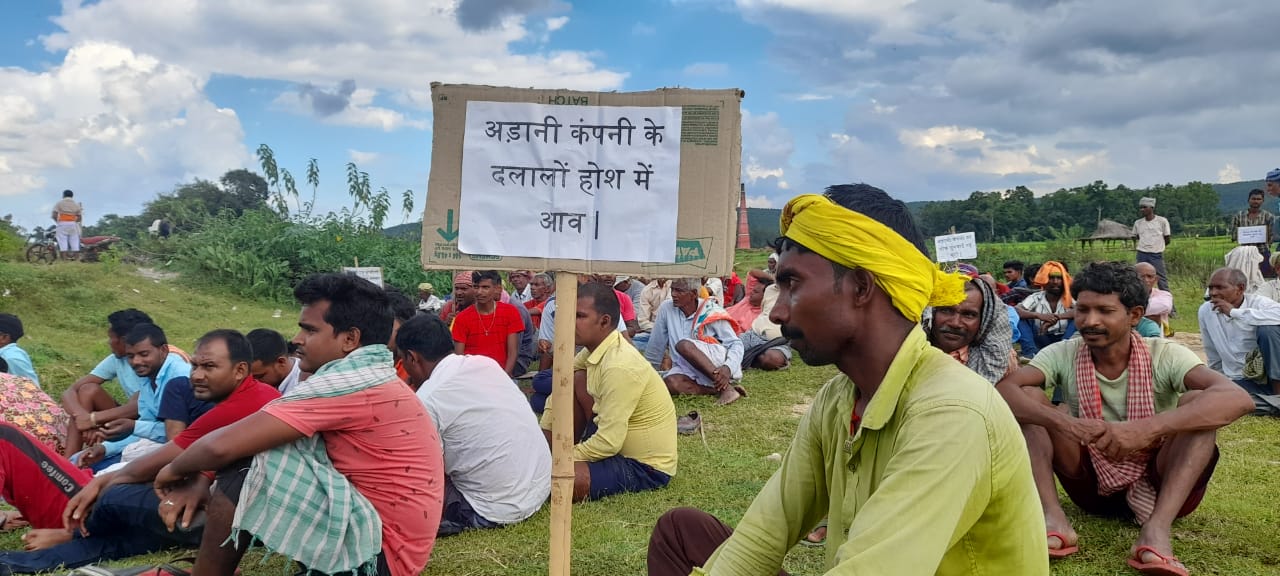
In Jharkhand’s coal-rich landscape, a historic struggle of rural resistance has reached a boiling point. On 11 November 2025, Harli village in Hazaribagh’s Barkagaon Block became the epicenter of one of the largest mahapanchayats, or grand community meetings, ever witnessed in the region. Over 10,000 residents, including Adivasis (indigenous tribals), Dalits, Muslims, and Other Backward Classes, converged to deliver a defiant, absolute rejection of multi-billion-dollar open-cast coal mining projects. Open-cast mining is a destructive method where giant pits are dug directly into the earth, stripping away everything on the surface. Chanting revolutionary tribal songs originally composed of defiance against corporate mining in Odisha, the crowd held placards saying "Adani Go Back" and vowed to defend their mother earth. This massive assembly marks a critical climax of a five-year-long battle against Adani Enterprises, the National Thermal Power Corporation (NTPC), and other corporate mining giants.
Adani and NTPC are the East India Company of Free India. The way our ancestors were fighting the British, we are feeling the same way. We have no support from the State government nor the Central government. We have no one behind us. And they are all trying to snatch our land from us. We are feeling helpless. They have made fake promises of jobs, houses and compensation to the people.— Maktoob
In this region, there are three major coal blocks, while in total there are seven coal blocks. The government, under pressure from the companies, keeps doing fake gram sabhas, and people protest against it. This means it is the company that the government is listening to. So we decided that this time, let us hold a mahapanchayat to give our own answer.— Maktoob
According to reporting by Maktoob from Harli, protesters explained that compensation rates remain terribly low, and they fear the arrival of corporations will break local religious and community brotherhood. Savanti Kumari, a resident of Harli, stated that NTPC had previously harassed and displaced people in neighboring towns, wrecking their environment. Activists also accused law enforcement of targeting them with fabricated police complaints, locally called First Information Reports (FIRs), in an attempt to intimidate and silence their peaceful demonstrations.
The scale of this community network has caught corporate executives by surprise. Only months before this massive gathering, on 28 March 2025, Adani Group Chairman Gautam Adani and Managing Director Rajesh Adani arrived in Ranchi for an unscheduled meeting. They spent over two hours at the residential office of Jharkhand’s Chief Minister, Hemant Soren. High-ranking bureaucrats, including Chief Secretary Alka Tiwari and Additional Chief Secretary Avinash Kumar, were present at this closed-door meeting. Gautam Adani requested Chief Minister Soren to resolve the long-standing disputes and administrative roadblocks delaying the Gondalpura Coal Block in Hazaribagh. To sweeten the deal, the Adani Group offered to supply Jharkhand's designated 400-megawatt share of electricity from its other Indian operations, given that the group's massive 1,600-megawatt power plant in Godda currently exports almost all of its electricity directly to neighboring Bangladesh.
Standoffs on the Ground: Feisty Farmers Send Officials Packing
But the political class cannot easily clear these roadblocks, because the villages have effectively halted the land acquisition machinery on the ground. On 22 December 2024, thousands of villagers armed with sickles and wooden sticks marched to a public meeting in Ambajit. The government had organized a public hearing there to discuss the transfer of 45 hectares of agricultural farmland to NTPC for coal mining. Unwilling to yield, the crowd overran the venue, tossed down chairs and tables, and directly confronted regional officers. They argued that the targeted land is irrigated, multi-crop farmland that feeds their families throughout the year. During the face-off, one of the local landowners, Chaita Mahto, shared his perspective with an independent correspondent.
Have you ever seen radishes this big? Yes, there is coal ten feet under my lands, but I put no fertiliser on my crops. My two sons are educated and working in the cities, but during harvest time, they take time off and come and work in our fields. I easily make two lakhs or so (about US $2500) per year from my two-three acres of land.— Adani Watch
The newly appointed local Circle Officer, Manoj Kumar, refused to sign a cancellation order for hours as angry women surrounded and heckled him. One of the regional council leaders, a member of the Zilla Parishad, mockingly offered him coal to eat, asking if coal could replace the rice and sugarcane currently produced by their soils. Around 4:00 PM, after intense shouting and phone calls, the officer finally signed the official cancellation document. The momentum from this victory continued into early February 2025, when Gondalpura residents held an indefinite sit-in and marched to Chandaul village to successfully cancel another public hearing, while physical altercations elsewhere required police to release corporate employees who were held hostage by frustrated villagers.
Communal Harmony and Police Warning Shots in Badam
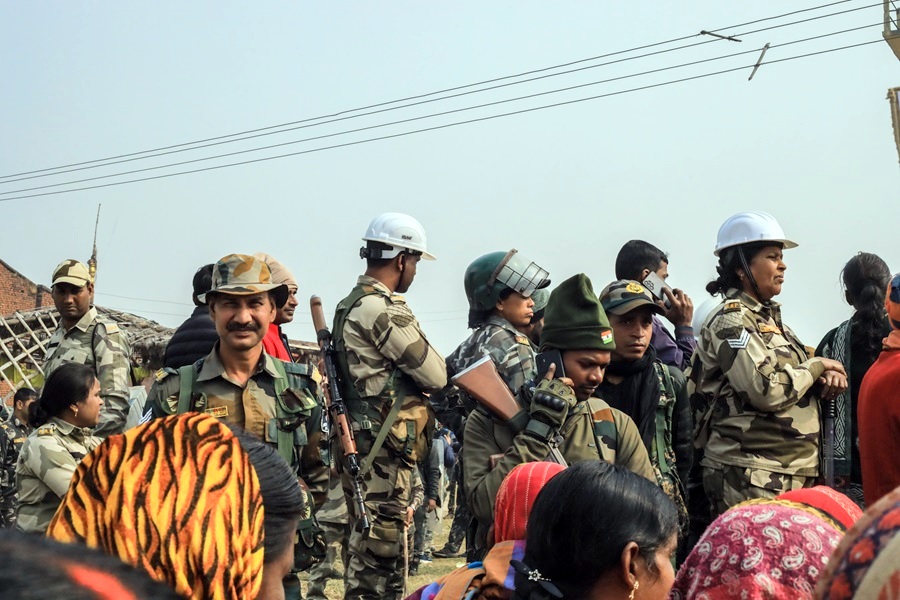
The determination of the villagers is driven by the memory of earlier, more violent face-offs. On 4 October 2024, a major clash occurred at the nearby site office of the BGR coal company. Villagers, furious over unauthorized mining preparations, broke down metal barricades and smashed the windows of company and police vehicles. Facing a large crowd of women and men, local police personnel fired live gunshots in the air to disperse the protesters. No journalists were invited to this demonstration because activists knew that direct action might occur to protest the mining developments.
Just two weeks earlier, on 21 September 2024, about 500 people had gathered for an organizational meeting at the football ground in Badam. This meeting laid the groundwork for the October direct action, drawing representatives from Gondalpura, Balodar, Galli, Harli, and neighboring hamlets. Highlighting the need for solidarity, Hindu and Muslim farmers pledged to ignore partisan politics and corporate handouts. Attendees agreed to completely boycott corporate social-responsibility gifts, including medicines, blankets, and school umbrellas. Speakers emphasized that if any of the overlapping coal blocks allotted to Rungta Mines, NTPC, or Jindal began operations, the interconnected local rivers would dry up, wiping out all 76 villages in the area.
What kind of situation is it, that you give your land to the government and beg for a job from a private company? You must realise it is 'ghulami' (slavery). They will give jobs to people from outside, from Chhattisgarh, Telangana, Andhra, and you will be greeting them again and again, 'namaskaar sir' or 'adaab sir.'— Adani Watch
Our villages have statues of Buddha in there. Do you want to trade thousands of years of history for thirty years of coal mining?— Adani Watch
The Threat to local Farmlands, Water, and Heritage
The focal point of this massive agrarian struggle is the Gondalpura coal block, which the government and Adani often misspell as "Gondulpara." Cleaved from Bihar in 2000, Jharkhand's population is heavily comprised of tribal communities (28%) and scheduled castes (12%), most of whom survive on traditional multi-crop farming. The proposed open-cast mine sits in the Hazaribagh District and directly targets 513 hectares of land. Over 219 hectares is natural forest, 70 acres consists of ancestor-owned common village lands known as Gair Majurwa, and the remainder consists of private farmlands. If this project proceeds, the peaceful villages of Gali, Phulang, Hahe, and Gondalpura will be entirely demolished, displacing between 500 and 1,950 peasant households.
Ecologically, the damage would be irreparable. Adani’s environmental clearance files reveal that the open-cast mine would generate 229 million tonnes of solid waste over its 32-year lifespan. This waste would be piled in huge dumps, requiring an additional 103 hectares of external land and risking toxic runoff. The corporate plan also involves pumping out millions of gallons of groundwater and building embankments to redirect the Badmahi River, a crucial tributary of the Damodar River, to prevent the main mining pit from flooding during monsoons. This ecosystem also lies just five kilometers from the ancient Isko cultural-heritage site, which contains prehistoric caves, rock art, and ancient archaeological overhangs.
This environmental cost is particularly galling because the field had previously been protected. In 2010, the central Ministry of Environment and Forests, under Minister Jairam Ramesh, placed Gondalpura under a "Category A" or "No-Go" list. This policy designated blocks with over 10% weighted forest cover or 30% gross forest cover as too ecologically valuable to mine. Ramesh argued that open-cast mining in these delicate regions would inflict severe, permanent damage to biodiversity that standard post-mining tree planting could never restore. However, the No-Go list was eventually shelved under intense pressure from the coal industry, and the block was provisionalized for auction in November 2020. Environmental scholars like Sreedhar Ramamurthi of the Environics Trust pointing out that Adani relies on outdated 2009 regulatory approvals originally issued to older state-joint ventures.
Most of the residents here are farmers who grow paddy and vegetables such as potatoes, tomatoes and peas throughout the year. If our land is taken away, we will meet the same fate as those of the families who were displaced by the NTPC's coal mining projects in Barkagaon a few years ago (Pakri-Barwadih and Chatti-Bariatu coal projects).— The Times of India
A Demilitarized Front of Unyielding Resistance
Ever since Adani won the license in 2020, local residents have out-maneuvered both corporate representatives and state authorities. In June 2021, when company managers Sunil Kumar and Krishab Shulka attempted to enter the region, local leaders flatly stated they would never yield their soil. By June 2022, when trucks and laborers arrived in Gondalpura to drill experimental bores, they were blocked and physically sent back by a wall of vigilant farmworkers. When Nabard, a development bank hired by the district administration, released a notification to conduct social impact surveys in September 2021, the Gram Sabha formally rejected the assessment.
In October 2022, corporate and district authorities tried to force pseudo-consent meetings through last-minute schedule changes. On 10 October 2022, when of a sudden 11:00 AM meeting in Balodar was rescheduled for 7:00 AM, villagers immediately mobilized, completely blocking the regional bridge to prevent company cars from crossing. Similar blocks occurred at Gali on 12 October and Gondalpura on 18 October, where hundreds of women stood at the borders, chanting "Save our water, forest, and land."
Three Gram Sabha public hearings were stopped by the locals in their attempt to oppose the project. The protests were silent and followed Gandhian ideals. The company officials had to return. Our movement is ongoing, every week in every village we are organising ourselves. We are using the form of baithaks [informal talks] to keep mobilising communities.— The Wire
This standard of community defense has deep roots. In 2006, when the same block was allocated to Tenughat Vidyut Nigam Limited (TVNL) and the Damodar Valley Corporation, local leaders like Parmeswar Mahto, an activist since the 1970s, organized persistent community defense. During a visit by the former District Collector, Manish Ranjan, Mahto held a chunk of coal in one hand and organic sugarcane jaggery in the other, challenging him to choose which was better to consume. Shrikant Nirala, a local headman, recalled that during a skewed public hearing in 2012, which was flooded with military police to intimidate locals, residents marched in and occupied the seats set aside for the panel of state officials.
I carried a piece of coal in one hand and some jaggery in another. I held both hands out to him and asked, which would you prefer to eat – the coal or the jaggery? sir, you talk about displacement. You’re appointed here, in Hazaribagh. If you get transferred elsewhere, would you go and see the quarter, or would you simply start packing up your belongings and leave?— The Wire Science
The five-year standoff in Hazaribagh shows the moral limits of corporate expansion in rural India. For the farmers of Gondalpura, Gali, and Badam, their rich soils produce major yields of sugarcane, potatoes, and paddy, ensuring a comfortable, self-sustaining livelihood. Trading thousands of years of ancestral history, sacred Buddhist archaeological relics, and pristine agricultural fields for thirty years of polluting open-pit coal extraction is a compromise they refuse to make. By standing up in absolute, cohesive community solidarity, these farmers are proving that people's power can successfully stop a corporate giant from decimating their lives.